1. find the expected number of rolls of an unbiased 6-sided die to get a 6, under the condition that every roll up to that point has resulted in an even number.
and so
and so
so :geom(2/3) and so
2. find the probability that n rolls of a 6-sided die form a non-increasing sequence.
Let denote the number of rolls of value Then given there is exactly one way to order the values in non-increasing order. The number of ways to allocate rolls of 6 values is the number of ways to allocate identical items to 6 bins. Using stars and bars, this is . There are possible rolls and so the probability is
3. find the probability that you win a game with a counterpart where you win if you roll a value strictly higher than the prior roll, and you roll first.
Let N be the first roll where the roll is higher than the prior roll. Then the first rolls is non-increasing. The probability that you win is the probability that is odd. Since
since
it follows that
and so
which works out to
4. You are given a bag with 3 red marbles and 7 blue marbles. You draw marbles one by one without replacement until all 3 red marbles have been drawn.
What is the expected total number of marbles you will draw?
There are ways to arrange 2 R balls into slots and 1 R ball in the nth slot. There are ways to arrange 3 R balls into 10 slots. So
Alternatively, using R balls as separators, B balls can be placed into 4 slots. So there are 7/4 B balls on average in each slot. So the expected number of balls drawn is 3 * 7/4 + 3 = 33/4.
4. You have a bag containing 9 fair coins and one biased coin that lands on heads with probability 0.8. You randomly select a coin and flip it, yielding a heads. What is the probability that a second flip will also yield heads?
The odds of selecting a fair coin vs the biased coin is 9:1. The odds are updated to 45/8 when a heads is observed after selection. Hence the probability that a second flip yields heads is 45/53 * 1/2 + 8/53 * 4/5 = 289/530
5. What is the probability that two 6’s are rolled in a dice game that ends when at least one 2 and one 3 have been rolled?
The number of 6’s is a function defined by . The game evolves on the markov chain below, which can be aggregated to the simplified chain.
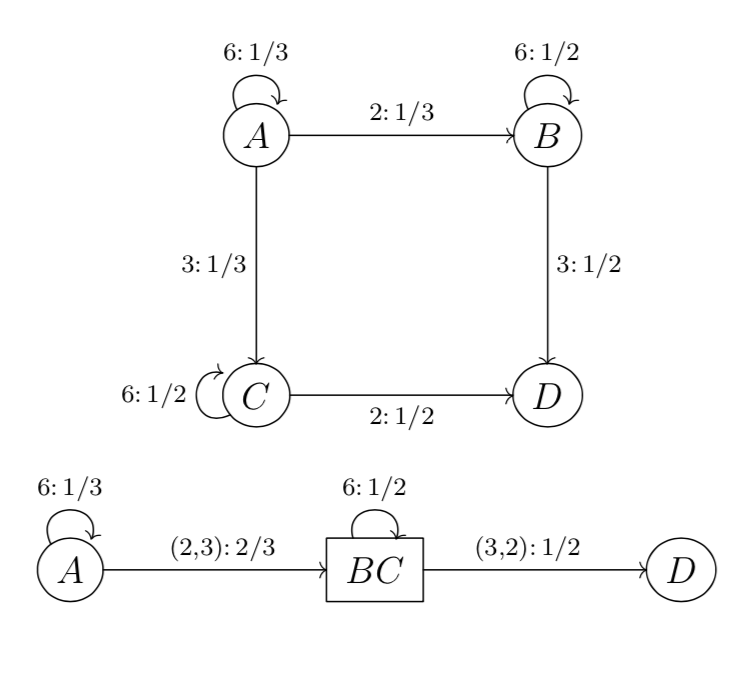
Two 6’s occur in the sequence iff
- 2 6’s occur at state A, 0 6’s occur at state BC
- 1 6 occurs at state A, 1 6 occurs at state BC
- 0 6’s occur at state A, 2 6’s occur at state BC
and so the probability that 2 6’s occur before the process reaches state D is given by
6. Consider an ant walking along the edges of a cube such that its movements between edges completely random. What is the expected number of moves to reach the vertex opposite its starting vertex?
Let the state of the markov chain denote the number of edges distant from the starting vertex the ant is located at. The Markov chain describing the ant’s behavior is given by

Let denote the expected number of steps to reach state 3 from state i. Then we have a system of equations described by
Solving this system gives
Alternative approach: This approach uses martingales and the OST. It is overkill but provides a conceptually distinct alternative to the plain-vanilla method, and is in the style of Conway
Let be the stopping time when the ant reaches state 3. First task is to construct a martingale of the form . The martingale conditon is
which requires in this case
and so the unknown function must satisfy
Which can be rewritten as
This is a system of 3 equations in 4 unknowns, so we can choose one of them, say . This gives
Using the optional samplying theorem, and so
and so
7. Consider a game where the payoff is zero if the player rolls a 6, and as long as the die roll is not a 6 the player accumulates a fortune of all die rolls. What is the optimal strategy to maximize expected fortune?
Assume the running sum to date is . The player has two options, stop or roll again: where is the outcome of the next die roll. To maximize expected fortune, stop iff
Explicit evaluation gives
and so stop when
8. What is the value of a contract that pays out given that where are independent D100 rolls?
Given the information, there are 139 equiprobable outcomes such that there are 70 outcomes of the form (70,*) and 69 outcomes of the form (k,70) where k=1..69. So the fair value is
8. Consider a standard 1D random walk, starting from position 0, given that state 3 is reached what is the probability that -1 is never touched?
Let be the probability that state 3 is reached given that state -1 is never reached. Then we have the following system of equations:
which gives
9. A segment of unit length is randomly split into 3 pieces. What is the probability the pieces can form a triangle?
By the triangle law, the sides of a triangle x,y,z satisfy where θ is the angle between sides x,y. Since cosθ ∈ [−1,1] and so |x − y| ≤ z ≤ x + y. This condition also is sufficient for the existence of an angle such that the triangle equation is satisfied. Now, let X, Y be the uniform(0,1) random variables where cuts occur. When X ≤ Y the lengths are X, Y − X, 1 − Y and so the condition in this case is
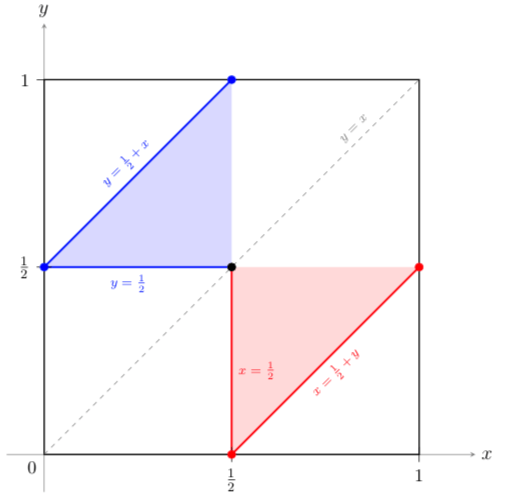
and so the probability that the pieces form a triangle is the sum of the areas of the shaded triangular regions, which is 1/4.
10. You shuffle a standad 52-card deck and deal cards one by one from the top until you have seen at least one ace and one king. what is the expected number of cards dealt?
Let be the number of cards to the fist ace and first king, respectively. Note that
and is the number of cards to see either, and to see at least one of both. Since there are 4 aces, and and by the identity above,
11. Starting with $2 and flipping a fair coin where each head returns $1 and each tail loses $1 and where the game ends when either $0$ or $5$ is hit, what is the expected number of coin flips until the game ends?
Let be the sequence of coin flips such that . Then the sequence is a martingale, as is . Let be the number of flips to reach the boundary. By the optional sampling theorem, and . Let be the probability that the boundary 5 is hit. Then and so . Also and so
12. Three numbers are independent and uniform(0,1) random variables. What is the probability that the largest of the three numbers is greater than the sum of the other two?
The events are mutually exclusive and equally likely. Conditioning on the outcome that the probability that
and so . So the probability is 1/6 * 3 = 1/2
13. A standard 52-card deck is shuffled. What is the probability that all four aces appear in the deck before the first king?
There are 4!4! sequences with 4 aces first, then 4 kings, and 8! total sequences, and so the probability is 1/C(8,4).
14. A stick of length 1 is broken into three pieces by picking two break points independently and uniformly along the length. conditional on the fist break being 0.3, what is the probability that the resulting pieces can form a triangle?
The pieces can form a triangle if the sum of the shorter lengths is at least as great as the longest length. If the break occurs below 0.3, then this is not satsified since . If the break occurs above 0.3, then the lengths are . If then the condition is not satisfied. If the condition is not satisfied. hence the condition is satisifed iff which has probability 0.3
15. Starting from a fortune of $1, a game is played where the player can stop or roll a fair D2 die such that the fortune is doubled when and fortune is 0 when and the game ends. When is it optimal to stop?
Let and let be the fortune sequence. Then and so the sequence is a martingale. For any bounded stopping time, the OST implies that and so it is optimal to stop at any time. If the game never stops, the process is not uniformly bounded, but the probability of going bankrupt is 1.
Let be the maximum fortune playing the game when the starting fortune is . Then . Indifference of choice occurs when . This implies and so assuming we reach the boundary, this implies that therefore it is optimal not to roll again.
16. Consider a game where each round a player can roll a D6 and generates a running fortune of the current fortune plus the outcome of the D6 when the roll is not equal to 6, and the game ends and the fortune is 0 if the roll is 6. What is the optimal strategy?
suppose there is a decision boundary such that at the boundary
and so . The optimal strategy is to continue rolling until one must stop or the fortune has reached a value of 15. To compute the value of the game, note that the optimal values can be computed iteratively:
17. How should you fairly price a contract whose payoff is the sum of two D10 dice such that your counterparty knows one values of the dice and you know neither?
Let be the ask. The contract value is . The counterparty will purchase the contract iff . The gain for you is
and it is fairly priced when . Let . Then by tower law, this gives and is a (the) solution. So the ask . This places the ask price the extreme top end of the valuation.

